
Example boards · built from one sentence
RP2350 flight controller
“4-layer RP2350 flight controller: 2-6S LiPo input with 5 V and 3.3 V regulators and battery voltage sensing, an ICM-42688-P IMU, a BMP390 barometer, 16 MB QSPI flash, four DShot motor outputs, a receiver UART and a GPS UART, USB-C, boot and reset buttons”A 4-layer flight controller for a quadcopter, built around the RP2350: it runs from a 2S to 6S LiPo, reads an ICM-42688-P IMU and a BMP390 barometer, drives four ESCs over DShot and talks to a receiver and a GPS. Designed from the one sentence above, down to the Gerbers and a priced bill of materials.
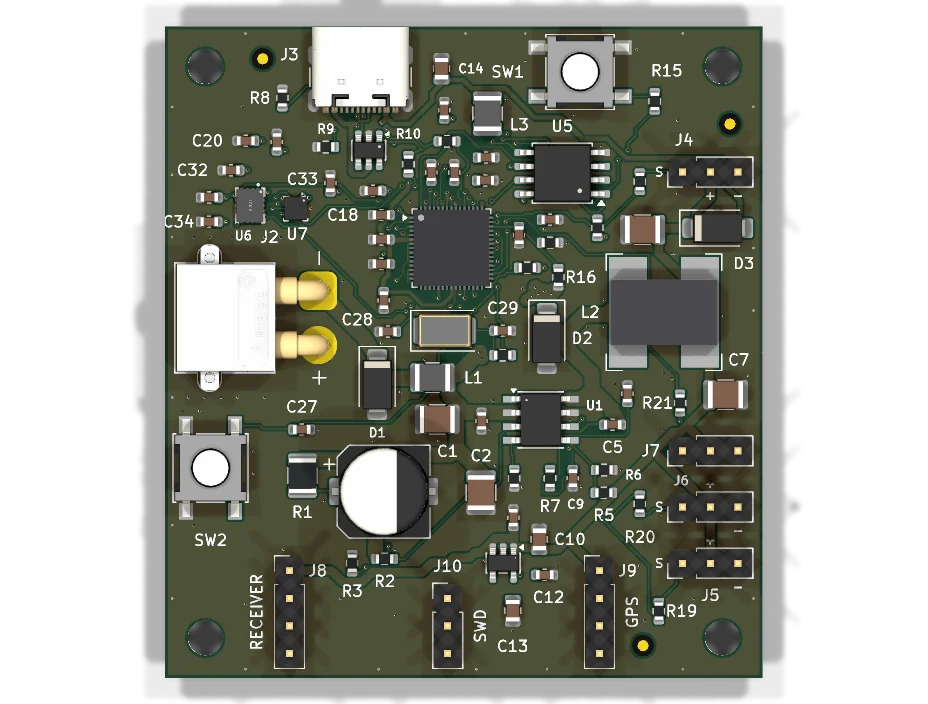
- Copper layers
- 4
- Board size
- 55 × 60 mm
- Parts
- 88
- Connections routed
- 225 of 225
- DRC errors
- 0
- Unconnected items
- 0
What came out of the sentence
- A KiCad schematic with stock library symbols and footprints
- A placed and routed KiCad board: every net connected, zero design-rule errors
- A bill of materials matched to Mouser and LCSC listings, priced at your quantity
- Gerbers, drill files and the CPL (pick and place) for JLCPCB, released because the board passed Koppar’s checks
Sign in with Google or your email. Opening a sample is free and does not use a design; your first three designs are on us.
What this RP2350 flight controller is for
- Your own flight controller hardware for a quadcopter or a fixed-wing build
- A board to develop RP2350 flight firmware on, with the IMU, barometer and motor outputs already wired
- A reference layout to adapt: another IMU, more motor outputs, a different battery connector
Design notes
How the RP2350 flight controller is put together, part by part.
Battery input for 2S to 6S
The pack comes in on an XT30. A SMAJ28A TVS clamps spikes on the battery line, a 4.7 µH inductor with damped bulk capacitance filters it, and a TPS54360 buck (60 V input) makes the 5 V rail.
3.3 V and the core supply
An AP2112K-3.3 makes 3.3 V from the 5 V rail; the RP2350’s own core regulator makes 1.1 V through its 3.3 µH inductor.
IMU and barometer on one SPI bus
The ICM-42688-P and the BMP390 share SCK, MOSI and MISO, each with its own chip select and interrupt line to the RP2350.
Four DShot outputs, receiver and GPS
Four 3-pin motor headers (5 V, signal, ground), each signal through a 100 Ω series resistor; 4-pin receiver and GPS headers with 5 V, ground and a UART each.
USB-C, flash and debug
USB-C with 5.1 kΩ CC pull-downs, a USBLC6-2SC6 ESD array and 27 Ω series resistors; a W25Q128JVS 16 MB QSPI flash; boot and reset buttons and an SWD header.
Schematic
The KiCad schematic, with stock library symbols. Open full size

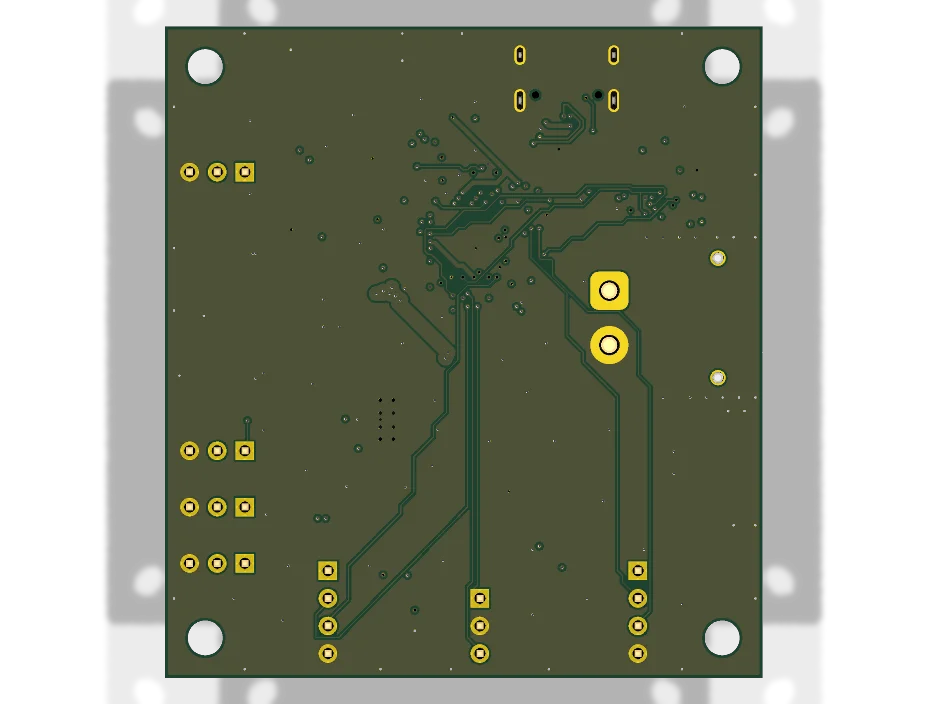
Both sides of the board
From schematic to Gerbers
What one sentence produced for this RP2350 flight controller, and what you take to a board house.
Schematic to PCB
The KiCad schematic, with stock library symbols and footprints, and the placed and routed board come from the same sentence: 225 connections on 4 copper layers, 55 × 60 mm, every net routed.
Design-rule clean before release
Koppar releases a board only when every net is connected, the KiCad design-rule check finds no errors, power traces are sized for the current they carry and every part has a footprint. This one: 0 DRC errors, 0 unconnected items.
Gerbers and assembly files
Gerbers and Excellon drill files, the CPL (pick and place) JLCPCB asks for, an assembly BOM with LCSC part numbers and IPC-2581: ready for a board house or an assembly service.
BOM with live pricing
51 lines matched to Mouser and LCSC listings, $43.25 of parts for one board at the last check. The studio re-prices them for your quantity and flags anything out of stock.
Bill of materials
51 lines matched to Mouser and LCSC listings: $43.25 of parts for one board, 2 lines out of stock at the last check. Prices and stock as of the last check; the studio refreshes them for your quantity.
| Refs | Qty | Value | Part | Source | Stock | Unit |
|---|---|---|---|---|---|---|
| C1, C2 | 2 | 10uF 50V X7R1210 | 1210B106K500NTFH (Guangdong Fenghua Advanced Tech) | LCSCC116808 | 56,779 | $0.283 |
| C3 | 1 | 100nF 100V0603 | CL10B104KC8NNNCSamsung Electro-Mechanics | LCSCC15725 | 732.8K | $0.01 |
| C4 | 1 | 100uF 35VCP | VEJ101M1HTR-0810Lelon | LCSCC176665 | 74,309 | $0.11 |
| C5, C19, C20, C21, C22, C23, C24, C27, C30, C31, C32, C33, C34, C35 | 14 | 100nF0603 | CL10B104KC8NNNCSamsung Electro-Mechanics | LCSCC15725 | 732.8K | $0.01 |
| C6, C7 | 2 | 47uF 10V1210 | GRM32ER61C476KE15LMurata Electronics | LCSCC77101 | 61,699 | $0.216 |
| C8 | 1 | 3.3nF0603 | CL10B332KB8NNNCSamsung Electro-Mechanics | LCSCC1613 | 304.7K | $0.009 |
| C9 | 1 | 22pF0603 | CL10C220JB8NNNCSamsung Electro-Mechanics | LCSCC1653 | 2.8M | $0.009 |
| C10, C14 | 2 | 10uF 10V0805 | CL21A106KAYNNNESamsung Electro-Mechanics | LCSCC15850 | 8.9M | $0.031 |
| C11, C12, C16, C17, C18 | 5 | 1uF0603 | CL10A105KB8NNNCSamsung Electro-Mechanics | LCSCC15849 | 11.8M | $0.009 |
| C13 | 1 | 10uF0805 | CL21A106KAYNNNESamsung Electro-Mechanics | LCSCC15850 | 8.9M | $0.031 |
| C15, C25 | 2 | 4.7uF0603 | CL10A475KO8NNNCSamsung Electro-Mechanics | LCSCC19666 | 3.2M | $0.014 |
| C26 | 1 | 10uF0603 | CL10A106KP8NNNCSamsung Electro-Mechanics | LCSCC19702 | 10M | $0.017 |
| C28, C29 | 2 | 15pF0603 | CL10C150JB8NNNCSamsung Electro-Mechanics | LCSCC1644 | 951.4K | $0.011 |
| D1 | 1 | SMAJ28AD | SMAJ28ADOWO | LCSCC283899 | 6,018 | $0.031 |
| D2 | 1 | SS56 60V 5AD | SS56Shandong Jingdao Microelectronics | LCSCC123947 | 1,881 | $0.049 |
| D3 | 1 | SS34D | SS34MDD(Microdiode Semiconductor) | LCSCC8678 | 2.5M | $0.034 |
| H1, H2, H3, H4 | 4 | M3MountingHole | not sourced | |||
| J2 | 1 | XT30 BATTAMASS | 25SH-B-02-TSAdam Tech | Mouser737-25SH-B-02-TS | 38,738 | $0.11 |
| J3 | 1 | USB4105-GF-AUSB | USB4105-GF-AGCT | Mouser640-USB4105-GF-A | 377.8K | $0.80 |
| J4 | 1 | DSHOT1PinHeader | PH2.54-1X3P-H25JXTCONN | LCSCC42431836 | 25,582 | $0.016 |
| J5 | 1 | DSHOT2PinHeader | PH2.54-1X3P-H25JXTCONN | LCSCC42431836 | 25,582 | $0.016 |
| J6 | 1 | DSHOT3PinHeader | PH2.54-1X3P-H25JXTCONN | LCSCC42431836 | 25,582 | $0.016 |
| J7 | 1 | DSHOT4PinHeader | PH2.54-1X3P-H25JXTCONN | LCSCC42431836 | 25,582 | $0.016 |
| J8 | 1 | RECEIVERPinHeader | PZ2.54-1X4P-H25JXTCONN | LCSCC42431787 | 18,165 | $0.021 |
| J9 | 1 | GPSPinHeader | PZ2.54-1X4P-H25JXTCONN | LCSCC42431787 | 18,165 | $0.021 |
| J10 | 1 | SWDPinHeader | PH2.54-1X3P-H25JXTCONN | LCSCC42431836 | 25,582 | $0.016 |
| L1 | 1 | 4.7uH1210 | NLV32T-4R7J-PFTDK | LCSCC76842 | 28,792 | $0.053 |
| L2 | 1 | 8.2uHL | CKCS8040-8.2uH/MCENKER | LCSCC5291897 | 73 | $0.102 |
| L3 | 1 | 3.3uH1210 | NLV32T-3R3J-EFTDK | LCSCC295115 | 2,583 | $0.047 |
| R1 | 1 | RC1210FR-070R47L1210 | unparseable value | |||
| R2, R16 | 2 | 100k0603 | 0603WAF1003T5EUNI-ROYAL(Uniroyal Elec) | LCSCC25803 | 13.1M | $0.003 |
| R3 | 1 | 30k0603 | 0603WAF3002T5EUNI-ROYAL(Uniroyal Elec) | LCSCC22984 | 1.8M | $0.002 |
| R4 | 1 | 237k0603 | RS-03K2373FTFH (Guangdong Fenghua Advanced Tech) | LCSCC304722 | 2,304 | $0.001 |
| R5 | 1 | 53.6k 1%0603 | RCA0353K6FLFHKR(Hong Kong Resistors) | LCSCC22369894 | 41,868 | $0.001 |
| R6 | 1 | 10.2k 1%0603 | RCA0310K2FLFHKR(Hong Kong Resistors) | LCSCC22369857 | 159.2K | $0.001 |
| R7 | 1 | 31.6k0603 | RS-03K3162FTFH (Guangdong Fenghua Advanced Tech) | LCSCC321852 | 29,856 | $0.002 |
| R8, R9 | 2 | 5.1k0603 | 0603WAF5101T5EUNI-ROYAL(Uniroyal Elec) | LCSCC23186 | 18.5M | $0.002 |
| R10, R11 | 2 | 270603 | RC0603FR-0727RLYAGEO | LCSCC137753 | 24,356 | $0.003 |
| R12, R14, R17 | 3 | 10k0603 | 0603WAF1002T5EUNI-ROYAL(Uniroyal Elec) | LCSCC25804 | 43.1M | $0.002 |
| R13, R15 | 2 | 1k0603 | 0603WAF1001T5EUNI-ROYAL(Uniroyal Elec) | LCSCC21190 | 40.9M | $0.002 |
| R18, R19, R20, R21 | 4 | 1000603 | 0603WAF1000T5EUNI-ROYAL(Uniroyal Elec) | LCSCC22775 | 12.2M | $0.002 |
| SW1 | 1 | BOOTSW | B3S-1000Omron Electronics | LCSCC2733655 | 1,979 | $0.362 |
| SW2 | 1 | RESETSW | B3S-1000Omron Electronics | LCSCC2733655 | 1,979 | $0.362 |
| U1 | 1 | TPS54360DDATI | TPS54360DDATexas Instruments | Mouser595-TPS54360DDA | 0 | $6.62 |
| U2 | 1 | AP2112K-3.3SOT-23-5 | AP2112K-3.3TRG1(MS)MSKSEMI | LCSCC22365427 | 79,571 | $0.079 |
| U3 | 1 | USBLC6-2SC6SOT-23-6 | USBLC6-2SC6HXY MOSFET | LCSCC5261088 | 69,396 | $0.041 |
| U4 | 1 | RP2350AQFN-60-1 | RP2350ARaspberry Pi | LCSCC42411118 | 6,604 | $1.31 |
| U5 | 1 | W25Q128JVSSOIC-8 | W25Q128JVSIQWinbond Elec | LCSCC97521 | 67,578 | $2.25 |
| U6 | 1 | ICM-42688-PICM-42688-P | ICM-42688-PTDK InvenSense | LCSCC1850418 | 1 | $25.49 |
| U7 | 1 | BMP390ST | BMP390Bosch Sensortec | Mouser262-BMP390 | 0 | $3.58 |
| Y1 | 1 | X503212MSB2GICrystal | X503212MSB2GIYXC Crystal Oscillators | LCSCC112573 | 29,387 | $0.285 |
Files
Released because the board passed Koppar’s checks: every net connected, zero design-rule errors, power traces sized for their current. Sign up to download them or open the project in the studio.
circuit.kicad_schKiCad schematicSign up to downloadcircuit.kicad_pcbKiCad board, placed and routedSign up to downloadgerbers.zipGerber layers and Excellon drill filesSign up to downloadorder.zipGerbers, CPL (pick and place), assembly BOM with LCSC numbers, fab settingsSign up to downloadcircuit-ipc2581.xmlIPC-2581, one-file CAM handoffSign up to downloadbom.csvBill of materials with distributor part numbers and pricesSign up to downloadboard.glb3D model of the assembled boardSign up to download
Questions about the RP2350 flight controller
What battery can it run from?
A 2S to 6S LiPo (7.4 V to 25.2 V full) through the XT30. The buck takes up to 60 V at its input, and the TVS on the battery line clamps spikes above the pack voltage.
How does it read the battery voltage?
A 100 kΩ / 10 kΩ divider on the filtered battery line feeds an RP2350 ADC pin: a full 6S pack at 25.2 V reads as about 2.3 V, inside the ADC’s 3.3 V range.
Can it run from USB alone?
Yes. USB-C VBUS feeds the 5 V rail through an SS34 Schottky diode, so the board starts and can be flashed with no battery plugged in.
Can I manufacture this RP2350 flight controller?
Yes. The Gerbers, drill files, CPL (pick and place) and an assembly BOM with LCSC part numbers were released with the board. Open it in the studio to download them and send them to a board house, with or without assembly.
Can I edit it in KiCad?
Yes. The schematic and the board are standard KiCad files with stock library symbols and footprints. Download the project from the studio, or describe a change there and Koppar designs the new version.
What do the parts cost?
$43.25 for one board at the last price check, 51 lines from Mouser and LCSC. Prices fall with quantity; the studio re-prices the BOM for yours and flags anything out of stock.
More boards from one sentence
- Breadboard power from a phone charger“Power my breadboard from a USB-C phone charger: 5 V and 3.3 V, an on/off switch and a little light so I know it's on”
- STM32 CAN-bus sensor node“12 V CAN-bus sensor node: STM32G0, CAN transceiver, 3.3 V buck and a screw terminal”
- ESP32-C3 sensor board with LiPo charging“USB-C powered ESP32-C3 board with a LiPo charger, a BME280 sensor on I²C and a status LED; USB-C and battery connector on the board edge”