
Koppar on 25 public open-hardware boards
25 public open-hardware boards, 2 to 8 layers, each scored by KiCad under its own rules. Koppar returned the most clean boards of the five routers compared, and the most boards connected without adding a DRC error.
The set is 25 public open-hardware boards, from two-layer breakouts to an eight-layer FPGA controller: 52 to 1,843 connections each, every board pinned to a fixed commit of its upstream project. Each one is routed from its human placement with the copper removed, and judged by KiCad under the board’s own project rules, and under its custom rules file where the project ships one. We ran Koppar once per board, on 21 and 22 October 2026, and set its results beside those published for four other routers on the same boards.
A few of the boards, as Koppar routed them and as their designers did:
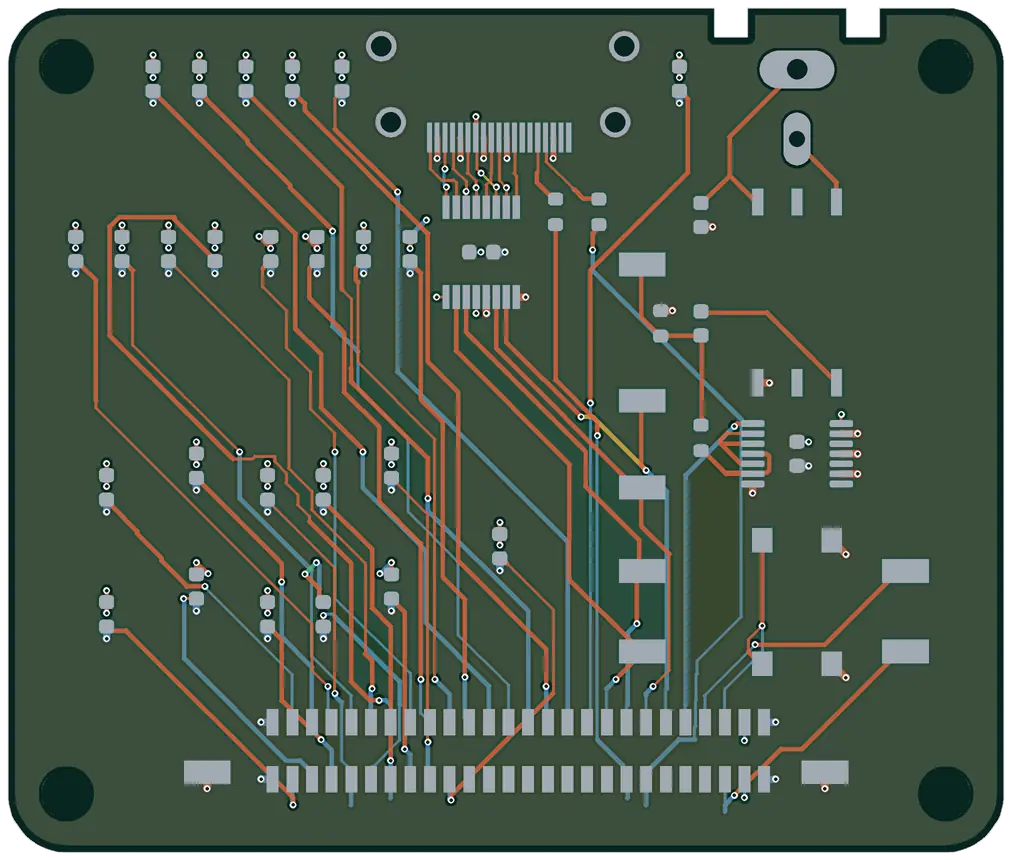
ecp5-bga381-ft22324 layers144 connectionsKoppar: 0 open, 0 DRC errors, 30 sThe totals
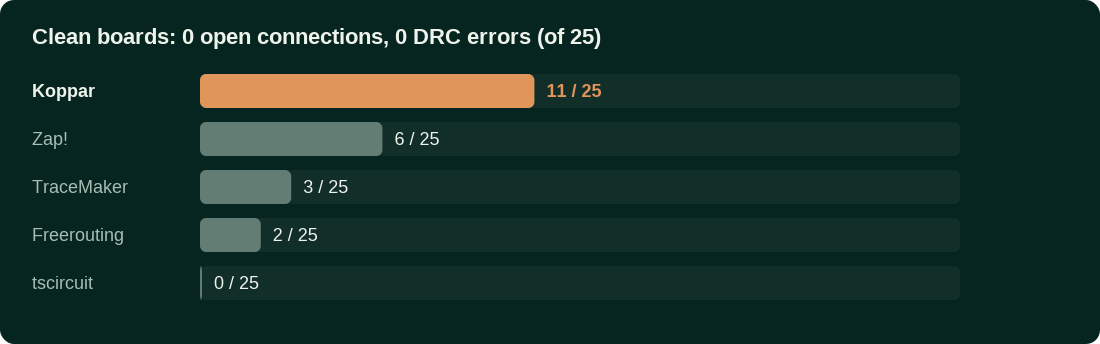
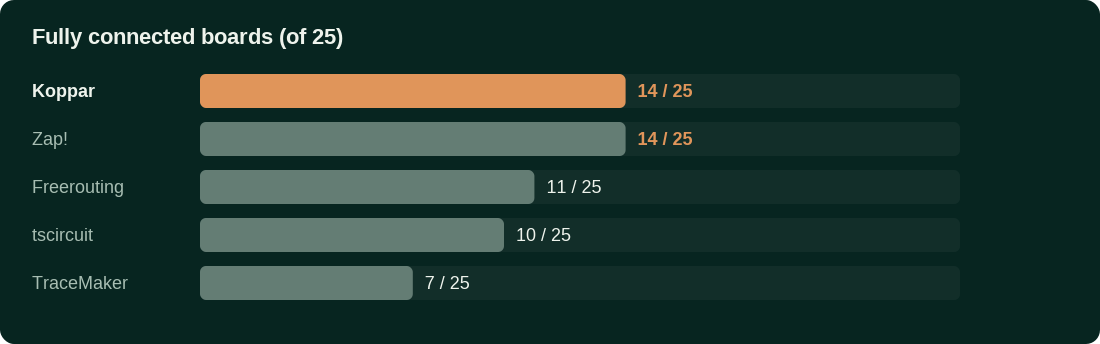
| Router | Fully connected | Clean (0 open, 0 errors) | Connected, no more errors than the human board |
|---|---|---|---|
| Koppar | 14 | 11 | 14 |
| Zap! | 14 | 6 | 9 |
| TraceMaker | 7 | 3 | 4 |
| Freerouting | 11 | 2 | 2 |
| tscircuit | 10 | 0 | 0 |
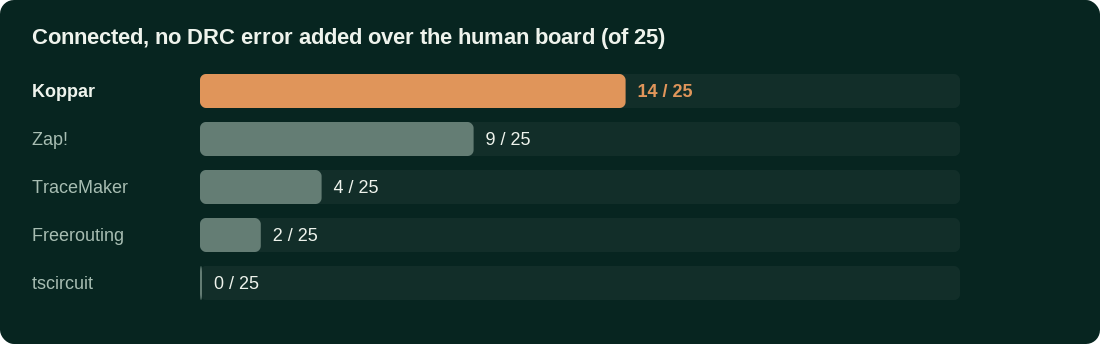
A board’s own design often carries a few DRC errors before any copper is drawn (overlapping courtyards, a footprint mismatch), so the last column counts a board as fine when routing it added none.
Where Koppar leads
Koppar returned the most clean boards, 11 against 6 for the next router, and the most boards fully connected without adding a single error over the published design, 14 against 9. It fully connects as many boards as the best of the others, 14, including xerxes and gmsl-serializer, which Zap! leaves open. On small and medium boards it is quick: si-test-board clean in 10 seconds, trellis-core in 19, ftdi-jtag-programmer in 153.
Where it trails
Zap! fully connects as many boards, 14, but not the same ones: it connects stm32h7-hdmi-sodimm and discretesim-hwtest, which Koppar leaves open, and on most of the boards neither router finishes it leaves fewer connections open. Koppar trails in two groups:
- the large 6- and 8-layer carriers (hackrf-pro, tiliqua-motherboard, emberone, kintex-pcie, stm32h7-hdmi-sodimm);
- fine-pitch two-layer boards (rp2040-devboard, discretesim-hwtest).
Those are the boards we are working on next.
How to read the numbers
- Different machines. The other routers’ numbers were measured on one CPU core per board; Koppar ran on one workstation with a GPU, under a 20-minute cap per board. Compare the outcomes, not the seconds.
- One run per board. Routing is a timed search; a board near the cap can pass in one run and miss in another.
- KiCad is the referee. Every count is KiCad’s DRC report with pours refilled (KiCad 10.0.4 for Koppar, 10.0.6 for the published runs).
Sources
The board list, the commits and the four other routers’ results come from the comparison Mutual Solutions published with its Zap! router; we did not re-run them. Koppar’s results per board and the harness are in autorouter-bench, and the full table is on our benchmarks page.
Describe the circuit. Get the board.
See what Koppar does